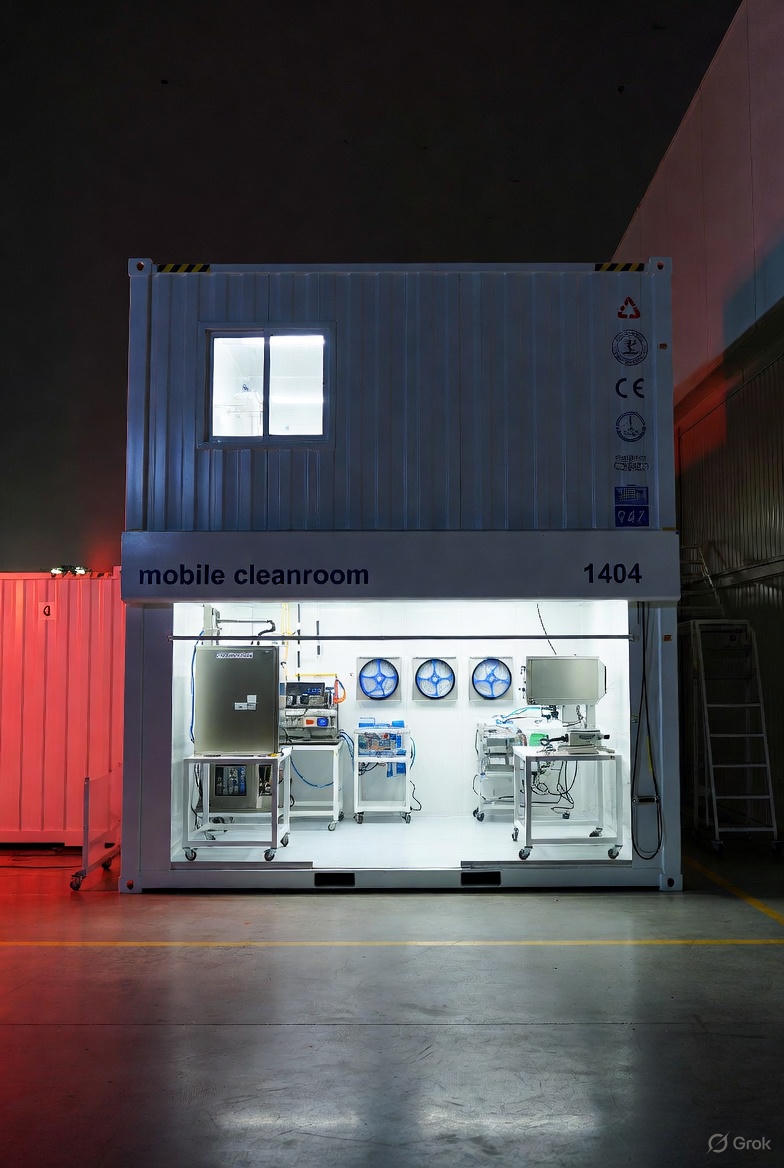
What Exactly is a Mobile Cleanroom and When Did It Enter the Iranian Industry?
A mobile cleanroom or Modular Cleanroom Container is a fully independent and portable unit that incorporates all components of a fixed cleanroom (walls, ceiling, air handling unit, filtration, lighting, pressure control, and monitoring) inside a standard 20 or 40-foot container structure, trailer, or custom dimensions.
The first serious models in Iran were used in 2019–2020 for producing rapid COVID-19 detection kits and the CovIran Barekat vaccine, and from 2022 onward, they rapidly expanded in pharmaceutical, laboratory, military, and emergency projects.
By the end of 2025, more than 180 prefabricated cleanroom units in Iran have received GMP or ISO 14644 certification.
Which Cleanliness Classes Are Truly Achievable? (Based on Real Experiences 2022–2025)
| ISO Class | In At Rest State | In Operational State | Percentage of Successful Projects in Iran to Date |
|---|---|---|---|
| ISO 5 (Grade A) | Hardly achievable, only with internal isolator | Less than 3% | |
| ISO 6 (Grade B) | With severe limitations | About 12% | |
| ISO 7 (Grade C) | Fully stable and common | More than 71% | |
| ISO 8 (Grade D) | Very stable | More than 95% |
Practical Conclusion: If you need direct Grade A, a containerized cleanroom alone is not sufficient; you must install an isolator or RABS inside it.
Physical and Engineering Limitations That Are Usually Not Told to You
- Useful internal height of a standard high-cube container is only 2.39 meters → After installing ceiling laminar flow and raised floor, ultimately 2.05–2.10 meters of free height remains (problematic for tall individuals and tall equipment).
- Weight and transportation: A fully equipped 6×3 meter ISO 7 unit weighs about 9–11 tons → Requires lowbed trailer and traffic overload permit.
- Vibration and shaking on uneven ground or during relocation can cause panel screws to loosen or even HEPA filter leaks → Must be installed on concrete foundation or vibration isolator plate.
- Heat dissipation of air handling units: Integrated AHUs are usually mounted on the roof with condenser outside → In very hot regions (Ahvaz, Bandar Abbas), condenser temperature reaches 55°C and efficiency drops.
Mandatory Standards for Acceptance by Food and Drug Administration and Ministry of Health (Regulations 2024–2025)
- Structure must at least comply with ISO 1496-1 container standard
- Panels must have Class A fire certification (BS 476 or DIN 4102)
- AHU must have VDI 6022 or EN 1886 certification
- Particle, air velocity, pressure, and Recovery Test must be performed at the final project site (not at the manufacturer's factory)
- Continuous particle and pressure monitoring with at least 1 year of logging
- Doors and pass-boxes must comply with GMP Annex 1 2022 edition
Technical Comparison of Three Generations of Containerized Cleanrooms in Iran
| Generation | Years | Panel Type | AHU Type | Maximum Stable Class | Average Cost for 20 m² (Billion Tomans) |
|---|---|---|---|---|---|
| First Generation | 2019–2021 | 4 cm ordinary sandwich panel | Separate AHU on ground | ISO 8 | 0.6 – 0.9 |
| Second Generation | 2022–2023 | 6 cm polyurethane 40 kg/m³ panel | Roof-mounted AHU | ISO 7–8 | 1.2 – 1.8 |
| Third Generation (2025) | 2024–Present | 60–80 mm panel + raised floor | Integrated hygienic Plug Fan AHU | Stable ISO 7 (limited ISO 6) | 1.8 – 3.4 |
Real Experiences from Successful and Unsuccessful Projects (Without Mentioning Company Names)
Successful Project: Reference Health Laboratory – Winter 2024, ISO 7 class – 24 m² area – 18-day delivery – Over 420,000 PCR tests without contamination to date.
Semi-Successful Project: Serum production factory in the south – Summer 2024, due to installation on soil ground without vibration isolator, Recovery Time reached 28 minutes (allowed limit 15 minutes) → Forced to pour concrete and add anti-vibration plate.
Unsuccessful Project: A biotechnology startup – Spring 2023, purchased cheap first-generation model → Severe HEPA filter leak during transport → Entire project canceled.
Complete Checklist Before Ordering a Containerized Cleanroom (38 Key Items)
- Exact internal dimensions after installing false ceiling and floor?
- Total unit weight and required crane tonnage?
- How many actual air changes per hour does the AHU provide? (Not theoretical)
- Does it have backup power and UPS for at least 30 minutes?
- Are HEPA filters 100% scanned with serial report?
- Do panels have Class A fire certification?
- Does it have 24/7 monitoring system with SMS alert?
- Possibility of connection to main factory BMS?
- How many years warranty for structure and equipment?
- Is final testing done at project site or only factory?
Real Conclusion (Without Sales Pitch)
In 2025, containerized cleanroom is a very powerful and fast solution for the following conditions:
- Emergency and urgent production
- Continuing production during main line reconstruction or repair
- Short-term research projects
- Remote and emergency areas
- Mobile molecular diagnostic laboratories
But for routine long-term production of sterile injectable drugs Grade A/B, it still does not replace fixed cleanrooms and is better used as a supplement.
If your project falls into the above cases, a prefabricated cleanroom can reduce setup time from 10–12 months to 2–4 weeks and cut costs by up to 60%, provided correct specifications are chosen from the start and final tests are performed at the project site.
Ultimately, the decision is yours; speed and flexibility versus long-term stability. Both choices are valid, you just need to know exactly what you want.